
Table of Contents
- Emergency Steps: How to Stop a Toilet From Overflowing
- How to Unclog an Overflowing Toilet Safely
- Toilet Overflowing but Not Clogged: Tank and Fill Valve Checks
- How to Fix a Toilet Overflow Tube
- Multiple Fixtures Backing Up: When It’s the Sewer Line
- Cleanup, Sanitation, and Water-Damage Precautions
- When to Call a Plumber for an Overflowing Toilet
- Conclusion
- Frequently Asked Questions
Last Updated: October 21, 2026
Emergency Steps: How to Stop a Toilet From Overflowing
An overflowing toilet is a race against time: every second the water runs, it spreads across the floor and creeps toward rooms below.
An overflowing toilet happens when water enters the bowl faster than the drain can carry it away. The cause is a blockage or a tank part that won’t stop refilling, but the emergency steps below work for both.
Here is the order that limits damage:
- Stop the water at the source.
- Keep the bowl from refilling.
- Remove standing water before it spreads.
- Find out why it happened.
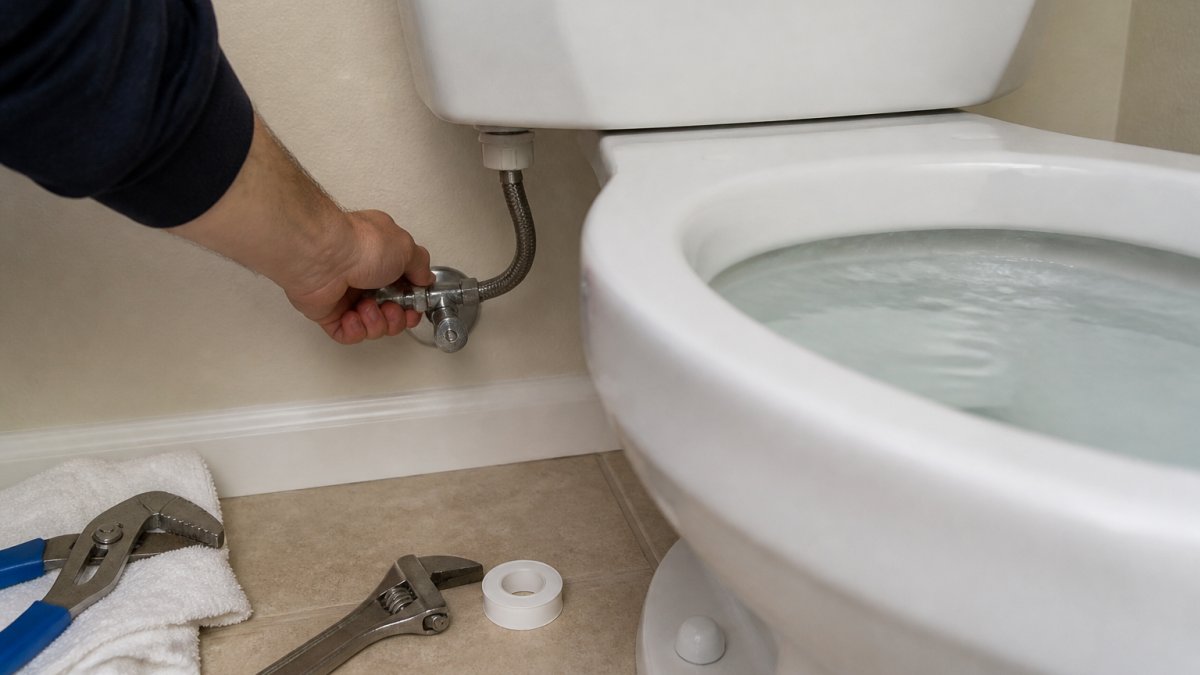
Shut Off the Water Supply at the Shutoff Valve
The shutoff valve is the fastest way to stop the water.
Most valves close in a quarter to a half turn. If the knob is stiff, grip it firmly and turn slowly. Do not force it past its stop.
If the valve won’t budge or the handle snaps, move to the next step.
Stop the Fill Valve and Drain the Tank
If the shutoff valve fails, stop the fill valve directly. Lift the tank lid, find the float (a ball on an arm or a cup on a vertical post), and hold it to the top of the tank; the fill valve should close and the water should stop.
Next, drain the tank so it can’t refill the bowl:
- Flush once only if the bowl is not near the rim.
- Otherwise, soak up water in the tank with a cup or towel.
- Press the flapper down and hold it until the tank is empty.
Never keep flushing a toilet that is already spilling over. Each flush adds roughly a gallon or more to a bowl that cannot drain it, and that is how a small mess becomes water damage.
How to Unclog an Overflowing Toilet Safely
Once the water is under control, clear the blockage. How to unclog an overflowing toilet safely comes down to matching the tool to the clog, working in the right order, and knowing when to stop: a flange plunger first, a toilet auger second, and no chemical drain cleaner or sink snake at any point. Chemical cleaners can splash back onto skin and fixtures and do nothing for paper-and-waste clogs, while a sink snake is too short and stiff for the trapway and can scratch the porcelain.
First, Judge the Clog Severity
Before you pick up a tool, decide which of three situations you are in.
- Soft clog, bowl drains slowly but does not rise. Usually paper or waste caught in the trapway. A plunger almost always clears it.
- Hard clog, bowl fills to the rim when flushed and drains very slowly. Often a foreign object, wipes, or a buildup in the trapway. Plunger first, then auger.
- No-drain clog, flushing sends water straight to the rim with no drop. The trapway is fully blocked. Skip straight to the auger; plunging a fully blocked bowl just pushes water up and over the rim.
If you cannot tell which one you have, flush once with the shutoff valve half closed so water enters slowly, giving you a few seconds to watch the bowl level before it climbs.
Plunger Technique That Actually Seals
A flange plunger is the only plunger that works well on a toilet. The rubber cup has a fold-out flap that seals against the bowl outlet.
Use it like this:
- Wait until the water in the bowl covers the cup; if the bowl is nearly empty, add a cup of water first so the seal forms.
- Fold the flange out and seat the cup fully over the drain hole at the bottom, not over the front of the bowl.
- Push down slowly to compress the trapped air, then pull up fast. The pull is what moves the clog; the push just sets the seal.
- Repeat 10 to 15 times, keeping the cup sealed between strokes.
- Break the seal on the last pull, then flush once with the shutoff valve partly closed to test.
If the water level does not drop after two rounds of 10 to 15 strokes, stop plunging. More force on a hard clog can drive it deeper or crack the wax ring under the base.
Toilet Auger: When and How to Use It
A toilet auger, also called a closet auger, has a crank handle and a wire coil inside a protective sleeve that keeps the coil from scratching the porcelain as you feed it into the trapway.
- With the bowl partly drained, feed the coiled end into the drain until you feel resistance.
- Crank clockwise only; turning it backward can kink the wire coil and ruin the tool.
- When the coil stops moving forward, you have hit the clog. Keep cranking clockwise with light forward pressure; the head will either break through or hook the material.
- Pull the coil back slowly to bring the clog out, then flush once with the shutoff valve partly closed to test.
Crank the auger clockwise only. If the coil stops moving forward, you have hit the clog, so keep cranking rather than forcing it. Forcing a kinked coil back into the sleeve is how most augers get ruined.
When to Stop and Call a Plumber
Call a licensed plumber if any of these happen:
- The auger reaches the clog but will not clear it after two or three attempts.
- The bowl drains but the clog returns within a day or two.
- Water backs up in the tub, shower, or a floor drain when you flush.
Repeated plunging and augering on a main-line clog can push waste farther into the line and enlarge the repair; a plumber with a sewer camera can tell a trapway clog from a line blockage in minutes.
Toilet Overflowing but Not Clogged: Tank and Fill Valve Checks
A toilet overflowing but not clogged is almost always a tank problem. If the bowl drains fine on a normal flush but the water keeps rising afterward, something is letting water into the bowl when it shouldn’t.
Check these parts:
| Part | What to Look For | What It Means |
|---|---|---|
| Fill valve | Water keeps running after the tank fills | Valve needs adjusting or replacing |
| Flapper | Visible gap, warped rubber, or water trickling into the bowl | Flapper is not sealing, so replace it |
| Float | Set too high, so the tank overfills | Lower the float to the marked water line |
| Overflow tube | Water pouring into it from the tank | Tank water level is set too high |
| Fill tube | Disconnected or pushed too far into the overflow tube | Reclip it above the water line |
The quick test: mark the tank water level with a pencil, wait 20 minutes, and check it again. If the level rose, the fill valve is passing water.
How to Fix a Toilet Overflow Tube
The overflow tube is the open-ended standpipe in the middle of the tank and a safety device: when the tank overfills, water spills down the tube and into the bowl instead of onto the floor.
How to fix a toilet overflow tube starts with the tank water level. Most tanks have a mark on the back wall or the overflow tube itself; adjust the float so the water sits about an inch below the top of the tube.
Adjust the Float by Type
- Float arm type (ball on a brass or plastic arm): turn the adjustment screw on the fill valve a quarter turn at a time, or bend the arm down slightly. Bend gently; a creased arm will not hold its setting.
- Cup float type (float slides on a vertical post): squeeze the clip and slide the float down the post a quarter inch at a time, then test.
- Fill valve with a level screw: turn the screw counterclockwise to lower the level. Some models use a lock ring instead of a screw; release the ring, slide the body down, and relock it.
After each adjustment, flush once and watch where the water settles. The target is roughly an inch below the top of the overflow tube, or at the water-line mark molded into the tank.
Check the Refill Tube for Siphoning
The refill tube is the small flexible hose that runs from the fill valve to the top of the overflow tube. It should clip to the top of the overflow tube and stop above the water line. If it sits below the water level, tank water siphons into the bowl and the toilet runs constantly, a refill-tube placement problem that looks like an overflow-tube problem.
- Reclip the tube so its end sits above the overflow tube’s rim, not inside it.
- If the clip is missing, a short piece of wire or a zip tie can hold the tube in place without blocking flow.
- Check that the tube is not kinked or pushed too far down the overflow tube; either reduces refill and can cause a weak flush.
Tell an Overflow-Tube Problem From a Flapper Leak
A high water level and a leaking flapper both make the toilet run, but the fixes differ. Run this test before replacing anything:
- Mark the tank water level with a pencil.
- Shut off the water supply and wait 20 minutes.
- If the tank level dropped, the flapper is leaking past its seal. If the tank level held but the bowl level climbed, the fill valve is passing water or the float is set too high.
A flapper with a visible gap, warped rubber, or a trickle into the bowl needs replacing; one that seals while the tank still overfills points back to the float or fill valve. Replacing the flapper when the real problem is the fill valve is the most common wasted trip to the hardware store.
If the overflow tube itself is cracked or loose at the base, water can leak past it into the bowl or onto the floor even when the level is correct. Shut off the supply, drain the tank, and replace the overflow tube assembly rather than trying to seal a crack with tape or caulk.
When to Replace Rather Than Adjust
Adjust the float first; it is free and reversible. Replace the fill valve or overflow tube assembly when:
- The water level will not stay put after two adjustments.
- The fill valve runs continuously with the float held at the top of the tank.
- The overflow tube is cracked, loose, or scaled so heavily that water backs up around it.
A fill valve and overflow tube kit is a common hardware-store item, and the job is a shutoff, drain, and swap rather than a plumbing call, provided the shutoff valve closes fully.
Multiple Fixtures Backing Up: When It’s the Sewer Line
One overflowing toilet is usually a local clog. Two or more fixtures backing up at once points to the main sewer line, which changes the plan.
Watch for these signs:
- The shower or tub drains slowly when the toilet flushes.
- Water bubbles up in the tub or a floor drain.
- More than one toilet gurgles or overflows.
Stop using water in the whole house. Every flush and every load of laundry adds to the backup. Then call a licensed plumber. A main line clog needs a sewer auger or hydro jetting, and no plunger will clear it.
If two or more drains are slow or backing up together, treat it as a sewer line problem and stop using water until a plumber inspects the line.
Cleanup, Sanitation, and Water-Damage Precautions
Toilet water is not clean water. Even after the overflow stops, the bowl water and anything it touched needs proper cleanup, or you risk a lingering smell, stained grout, and soft flooring.
Work through it in this order:
- Put on rubber gloves and open a window or run the exhaust fan.
- Soak up standing water with towels or a wet/dry vacuum.
- Wash hard surfaces with hot water and a disinfectant.
The wax seal under the toilet is the part most people forget. A failed wax ring lets water seep under the flooring and rot the subfloor; if the floor feels soft or the toilet rocks, the seal needs replacing.
When to Call a Plumber for an Overflowing Toilet
Some overflows are a quick fix; others need a professional. Call a licensed plumber when:
- The clog returns within a day or two.
- A toilet auger reaches the clog but cannot clear it.
- Water backs up in other fixtures.
At Arsenal Plumbing, our certified and insured plumbers have handled overflows, sewer line repairs, and hydro jetting for homes and businesses since 1993. We offer 24/7 emergency service, free estimates, and no hidden fees, so you know the price before we start. For a recurring backup, we diagnose the line with a free video inspection.
Conclusion
An overflowing toilet is stressful, but the fix follows a clear order: stop the water, clear the clog, then find the real cause.
When the water keeps coming back, or more than one fixture backs up, that is your cue to call in help. Arsenal Plumbing is available around the clock for emergency overflows, sewer line problems, and fixture repairs, with honest pricing and no surprise charges.
Frequently Asked Questions
How do you stop a toilet from overflowing immediately?
Reach behind the bowl and turn the shutoff valve clockwise until it stops, which cuts the water supply in seconds. If the valve is stuck or you can’t reach it, lift the tank lid and push the flapper down to seal the tank, or pull the fill valve float up. Then flush once to empty the tank so no more water enters the bowl. Acting within the first minute is the single best way to limit water damage on the floor and around the base.
Why is my toilet overflowing but not clogged?
When a toilet overflows without a clog, the fault is usually in the tank. A fill valve that won’t shut off keeps adding water, a flapper that leaks lets the tank refill continuously, or the overflow tube is set too high or cracked. Water rises past the rim and spills over. Shut off the supply, check the water level against the fill line, and inspect the flapper and fill valve for wear. Replacing those parts is inexpensive and usually solves it.
Is an overflowing toilet a biohazard?
Yes. Toilet water can carry bacteria, viruses, and other pathogens, so treat any spill as contaminated. Wear gloves and eye protection, keep pets and children away, and shut off the water before cleaning. Disinfect hard surfaces with a bleach solution or an EPA-registered disinfectant, discard porous items that soaked up the water, and wash your hands thoroughly afterward. If the water reached drywall, carpet, or subfloor, call a professional, since hidden moisture can lead to mold.
When should you call a plumber for an overflowing toilet?
Call a plumber if the water won’t stop after you shut the valve, if a plunger and auger fail to clear the clog, if multiple fixtures back up at once (a likely sewer line problem), or if sewage has soaked into walls or flooring. Recurring overflows point to a deeper issue like a failing fill valve or a blocked main line. A licensed plumber can camera the line, locate the blockage, and handle the repair and cleanup properly.