
Last Updated: November 8, 2026
Quick Summary
Hiring plumbers for rental property maintenance works best when you prioritize response speed, predictable pricing, and a single point of contact. Use a plumber who keeps records and returns to the same properties, and tie maintenance to move-in, move-out, seasonal, and annual inspection schedules.
- Look for response speed, predictable pricing, and a single point of contact.
- Document every fixture at move-in and move-out to create a dated baseline.
- Verify the contractor’s California license with the Contractors State License Board.
- Ask for quotes that separate dispatch fees, labor, parts, and warranty terms.
- Set a written emergency policy so only true emergencies trigger after-hours dispatch.
Table of Contents
- Why Rental Property Plumbing Needs a Different Hiring Approach
- Building a Rental Property Plumbing Maintenance Checklist
- Questions to Ask a Plumber Before Hiring
- How to Vet Plumbers for Your Rental Portfolio
- Setting Up a Plumbing Service Agreement for Property Managers
- Rental Property Plumbing Repair Costs and How to Control Them
- Landlord Duties, Tenant Communication, and Emergency Response in California
- Booking Your First Rental Maintenance Visit with Arsenal Plumbing
- Frequently Asked Questions
Why Rental Property Plumbing Needs a Different Hiring Approach
Hiring plumbers for rental property maintenance is not the same as hiring for a single-family home you own. A rental portfolio generates a steady stream of calls from tenants, often at inconvenient hours, and each unresolved leak becomes a habitability issue, a tenant complaint, and sometimes a dispute. Property managers tend to care most about three things: response speed, predictable pricing, and a single point of contact.
Many property managers find that a plumber who is excellent for one-off repairs is not always the right partner for recurring work. Maintenance across multiple units calls for scheduled inspections, clear documentation, and a crew that knows the buildings. For a deeper practical guide, see Plumbing Maintenance for Property Managers. Consider a manager with twelve units: a slow drain in one bathroom is a small job, but a pattern of slow drains across the building points to a shared line that needs a different solution.
Rental work also raises a question most homeowners never face: who pays, and under what authority? California landlords have specific repair obligations, and documenting each repair helps protect both the owner and the tenant.
Building a Rental Property Plumbing Maintenance Checklist
A rental plumbing checklist earns its keep when it is tied to the rental calendar, move-in, move-out, seasonal change, and annual inspection, rather than run as a generic walkthrough.
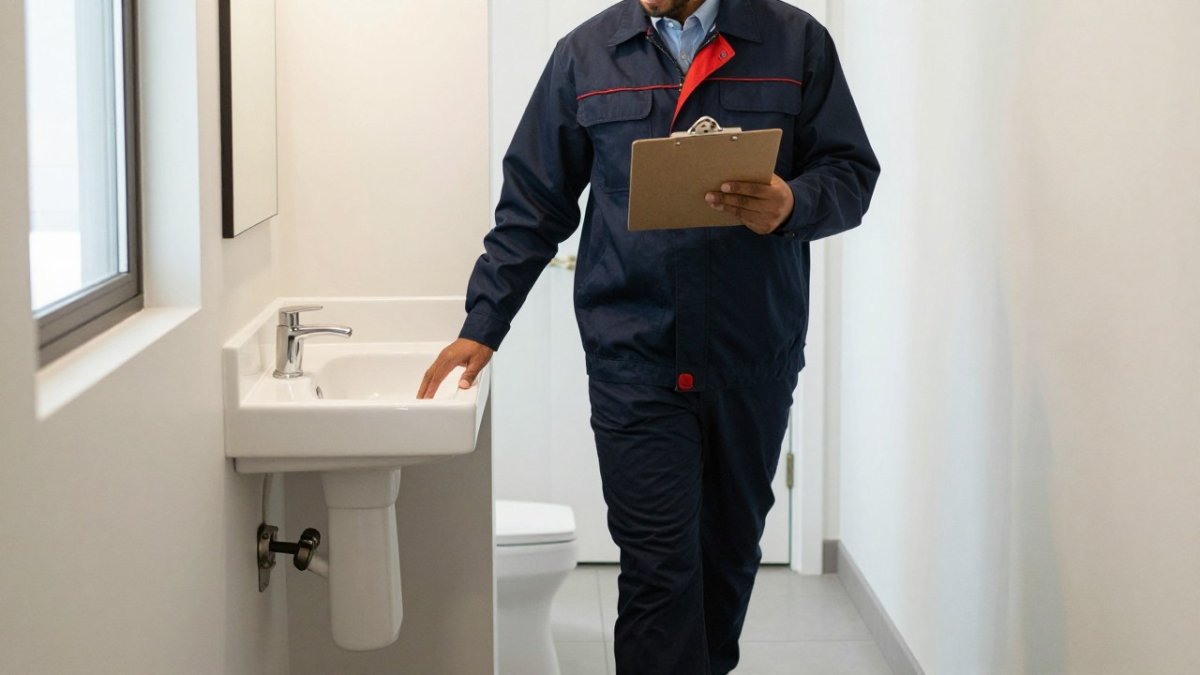
Quarterly walkthrough. Check water pressure at a hose bib or test port, look for staining on ceilings below bathrooms, run every fixture for a minute to listen for hammering or running water, and confirm shutoff valves under sinks and at toilets turn freely.
Seasonal checks. Before winter, confirm exposed supply lines in crawlspaces, garages, and exterior walls are insulated and that hose bibs are drained or covered. Before summer, check irrigation shutoffs and water-heater venting.
Annual deeper inspection. Once a year, have a plumber camera-inspect the main drain line, test the water heater’s anode rod and flush the tank, and check the main shutoff valve and pressure regulator.
Keep the record shared and unit-specific. Many managers keep the checklist in a shared spreadsheet keyed to unit number so on-site staff and contracted plumbers work from the same information.
Watch out: a checklist that is filled out but not dated and tied to a unit number will not help you later, an undated log is difficult to use as evidence of timely maintenance.
Questions to Ask a Plumber Before Hiring
Before you commit to any contractor, ask direct questions about how they work with landlords.
- How quickly do you respond to after-hours calls? Ask whether they offer 24/7 emergency service and what counts as an emergency.
- How do you price work? Ask whether quotes are fixed, what triggers an additional charge, and whether they provide estimates in writing before starting.
- Will you inspect before quoting? A video inspection or site visit is often the only way to avoid surprise costs.
- Who is my single point of contact? Rental work goes better when one dispatcher or project lead handles every request.
- Are you licensed, bonded, and insured? Confirm this before work begins, not after something goes wrong.
Arsenal Plumbing offers free estimates and a free video inspection with hydrojetting.
How to Vet Plumbers for Your Rental Portfolio
Vetting a plumber for a rental portfolio means checking more than online reviews. Start by confirming the contractor’s state license with the California Contractors State License Board, which lets you verify license status and any disciplinary history (Check A License). Then request a certificate of insurance naming you as an additional insured where appropriate.
Ask for references from other property managers, not only homeowners. To see how two specific providers compare, read Dutton Plumbing vs Titan Brothers Plumbing: An Honest Comparison. A plumber who handles multi-unit work will understand tenant access, scheduling around occupied units, and documentation requirements. Finally, run a small test job before committing to a service agreement. Note whether the crew arrived on time, communicated clearly, and cleaned up.
Verifying California Licensing and Insurance
California requires most plumbing contractors to hold a license issued by the Contractors State License Board (Licensing Classifications). Verify the license number on the board’s public lookup, check that the license classification covers plumbing, and confirm the license is active. Ask for proof of general liability insurance and workers’ compensation coverage. Keep copies on file for every vendor you use, and set a reminder to recheck expiration dates annually.
Setting Up a Plumbing Service Agreement for Property Managers
A plumbing service agreement formalizes what a property manager expects from a contractor. It typically defines response times for emergency and non-emergency calls, the scope of routine maintenance, how estimates are approved, and how invoices reference unit numbers and work orders.
Include a clause requiring written approval above a set dollar threshold, so no single repair escalates without your sign-off. Specify how and when you will be notified of recurring issues, since a repeated clog across units is a signal worth investigating. A well-written agreement also clarifies who handles tenant communication, which helps avoid disputes later.
Rental Property Plumbing Repair Costs and How to Control Them
Rental plumbing costs are driven less by the fixture than by how the job is dispatched, accessed, and documented. A property manager who understands the cost structure can compare bids on equal terms and keep per-unit spending predictable across a portfolio.
Know the line items before you compare quotes. A plumbing invoice for rental work typically breaks into four parts: the service-call or dispatch fee, the diagnostic or inspection charge, labor at a stated hourly or flat rate, and parts at a marked-up cost. Ask each contractor to quote those line items separately rather than as one lump sum. Two bids that look identical at the bottom line can differ sharply once you see that one bundles a two-hour minimum and the other charges a 30-minute dispatch fee plus actual time.
Separate emergency from standard rates. After-hours, weekend, and holiday calls usually carry a premium over standard business-hour rates, and the definition of ‘after-hours’ varies by company. A common pattern is a higher hourly rate plus a minimum call charge for nights and weekends.
Compare bids on scope, not just price. When two plumbers quote the same repair, check whether both include permit costs where a permit is required, disposal of old fixtures, drywall or access-panel repair, and a warranty period on labor and parts. A lower bid that excludes patching or haul-away is not actually lower. Ask for the quote in writing with the scope, the exclusions, and the warranty stated, and keep it with the work order.
Control recurring cost with batching and records. Schedule similar repairs across units into one visit so the dispatch fee and travel time are shared.
Use preventive spend to cap emergency spend. Budget a per-unit annual allowance for planned maintenance and treat emergency calls as the exception. Arsenal Plumbing offers free estimates.
Watch out: a quote that omits the service-call fee, permit cost, or warranty term can look cheapest up front and become the most expensive invoice once the job is complete.
The article breaks rental plumbing costs into the line items below, so compare bids on these terms.
| Cost item | What it covers | Note |
|---|---|---|
| Service-call or dispatch fee | Getting the plumber to the unit | Ask for it quoted separately |
| Diagnostic or inspection charge | Finding the cause of the problem | Ask whether it is billed separately |
| Labor | Time spent on the repair | Stated as hourly or flat rate |
| Parts | Materials used in the repair | Marked up from cost |
| After-hours call | Nights, weekends and holidays | Usually carries a premium rate |
| Permit cost | Required permits for the work | Confirm it is included in the quote |
| Warranty period | Coverage on labor and parts | Get the term in writing |
Landlord Duties, Tenant Communication, and Emergency Response in California
California landlords are generally required to keep rental units in habitable condition, which includes working plumbing, hot and cold running water, and functioning drainage. When a tenant reports a problem, respond promptly, document the report in writing, and schedule repairs with a clear timeline. For emergencies such as a sewage backup or a burst pipe, act the same day and keep the tenant informed of when the work will happen.
Good tenant communication reduces disputes. Acknowledge each request within a business day, explain the next step, and confirm access times in writing. Keeping these records shows you responded reasonably even when a repair took longer than anyone wanted.
Booking Your First Rental Maintenance Visit with Arsenal Plumbing
If you manage rental property in the San Fernando Valley and want a plumber who responds quickly and keeps clear records, start with a visit. Arsenal Plumbing has provided expert plumbing services to residents and businesses since 1993, and our certified and insured plumbers handle sewer line repairs and hydro jetting. Our 24/7 emergency service and free video inspection with hydrojetting are available to you.
Contact Arsenal Plumbing to schedule your first rental maintenance visit.
Frequently Asked Questions
How much should a plumber charge per hour?
Plumber rates vary by market, job complexity, and whether the work is scheduled or urgent, so Arsenal Plumbing does not publish a standard hourly figure here. Pricing depends on the scope of the repair, the time required, and the materials involved. Property managers should request a written estimate before work begins and confirm whether the quote covers labor, parts, and any after-hours or weekend surcharges. For current pricing or a quote on your rental units, contact Arsenal Plumbing directly through the website.
What should landlords look for when hiring a plumber?
Look for a plumber who is licensed with the California Contractors State License Board, carries general liability insurance and workers’ compensation coverage, and can show proof of both. Ask whether the company handles routine maintenance requests as well as emergencies, how quickly they typically respond, and whether they provide written estimates. Reviews from other property managers are useful, and a plumber who explains findings clearly and offers a video inspection before recommending major work is usually a sound choice.
Can a landlord charge a tenant for a plumber in California?
In most cases, California landlords are responsible for maintaining plumbing in a habitable condition under the state’s implied warranty of habitability, so the cost of repairing plumbing failures generally falls on the owner. Tenants are typically responsible only for damage they cause through misuse, such as a clog from flushing non-disposable items. Document the cause of every repair, keep written records, and consult a local attorney or tenant rights resource before deducting or billing a tenant for plumbing work.
How quickly should a landlord respond to a plumbing emergency?
Treat active leaks, sewage backups, and loss of water or hot water as emergencies that need same-day attention. Non-urgent issues such as a slow drain or a dripping faucet can usually be scheduled within a few days. Set clear expectations with tenants about which conditions qualify as an emergency, provide an after-hours contact number, and make sure your plumber offers 24/7 availability so urgent calls are not delayed.
Should landlords use one plumber for all rental property repairs?
Using one primary plumber across your portfolio simplifies scheduling, builds familiarity with each building’s plumbing history, and often leads to faster response times. A single trusted plumber can also track recurring problems across units. Keep a secondary provider in mind for backup coverage if your main plumber is unavailable, and review the relationship periodically based on response times, pricing transparency, and the quality of completed work.
What should a rental property plumbing service agreement include?
A service agreement for rental properties should define covered services, response-time expectations for emergencies and routine requests, pricing structure or rate schedule, approval thresholds for work above a set dollar amount, and documentation requirements such as itemized invoices and photos. It should also name the insurance and licensing the contractor must maintain and describe how after-hours calls are handled. Review the agreement annually to adjust rates and service levels.
