
Quick Summary
Hidden plumbing fees are charges that appear after the first quote, such as service call fees, diagnostic fees, parts markups, and added work. To avoid them, ask the plumber in writing what would raise the total and get an itemized estimate listing every charge.
- A quote that says “starting at” is not a final price.
- Ask whether the service call fee is charged even if you decline the repair.
- Ask whether the diagnostic fee is credited toward the final bill.
- Ask the plumber to contact you before doing any work outside the quote.
- Confirm the final total in writing before approving any work.
Table of Contents
- Why Plumbing Bills Grow Past the First Quote
- Questions to Ask a Plumber Before Hiring
- How to Read a Plumbing Estimate Checklist Line by Line
- Step-by-Step: Getting and Comparing Written Estimates
- Handling a Plumbing Change Order Before Work Begins
- Emergency and After-Hours Pricing: What to Confirm Up Front
- Booking Your Next Plumbing Visit With Arsenal Plumbing
- Frequently Asked Questions
Why Plumbing Bills Grow Past the First Quote
Last Updated: October 28, 2026
Hidden plumbing fees are the charges that show up after the first quote, and they catch many homeowners off guard. Knowing where extra costs can come from is the first step to avoiding them.
Surprise charges can come from service call fees, diagnostic fees, parts markups, or work added after a plumber opens a wall or pulls a fixture.
Watch out: A quote that says “starting at” is not a final price. Ask what would push the total higher before you agree to anything.
Here is what usually drives a bill past the first estimate:
- Scope creep: The plumber finds a second problem and adds it to the job.
- Unlisted fees: Dispatch, trip, or after-hours charges that were never mentioned.
- Parts markup: Materials billed well above what the plumber paid for them.
- Time-based billing: Hourly labor that runs longer than expected.
Ask what each charge covers before agreeing to work.
Questions to Ask a Plumber Before Hiring
Asking the right questions before any work starts can prevent most billing disputes. Ask for clear answers in writing.
- Is the service call fee charged even if I decline the repair?
- Is the diagnostic or inspection fee applied to the final bill?
- Do you mark up parts, and by how much?
- Will you contact me before doing any work outside the quote?
- Are you licensed in California, and are you insured and bonded?
- Do you charge extra for nights, weekends, or holidays?
Write down the answers. If a plumber avoids a question or gives a vague reply, consider it a warning sign.
How to Read a Plumbing Estimate Checklist Line by Line
A plumbing estimate should list every charge, not just a total. Read each line and check that it matches what was discussed. Use this checklist as you review:
- Labor hours and the hourly rate are both listed
- Service call or trip fee is shown separately
- Diagnostic or inspection fee is named and explained
- Each part is listed with its price
- Permit fees are included if the work needs one
- Cleanup or disposal charges are stated
- A total with tax is shown
- Payment terms and warranty details are written out
What each line item actually means
Here are examples of charges to ask about and what to confirm.
Service call or trip fee. This covers sending a technician to your address, regardless of whether any repair happens. It is sometimes called a dispatch fee. Ask whether it is charged when you decline the repair, and whether it is waived or credited if you approve the work.
Diagnostic or inspection fee. This pays for finding the problem: tracing a leak, camera-inspecting a drain, or testing a water heater. Ask whether the diagnostic fee is credited toward the repair before the visit.
Minimum labor charge. Ask whether a minimum service period applies and how it interacts with the trip fee.
Hourly labor. The estimate should show both the rate and the expected hours. Ask what happens if the job runs long and whether the plumber will pause to get approval before exceeding the estimate.
Parts and materials. Each part should be listed with its price. Ask whether parts are priced separately or included in a lump sum, and how the price is calculated.
Equipment and specialty charges. Ask whether equipment charges are included in the labor rate or billed separately.
Disposal and cleanup. Hauling away an old water heater, fixtures, or debris may be a separate charge. Confirm whether disposal is included.
Permits. Ask whether the work requires a permit and how any permit-related charges are handled.
After-hours, weekend, and holiday premiums. Ask whether after-hours, weekend, or holiday charges apply and how they are calculated.
Ask which fees are credited toward the repair if you approve the work. Ask which fees, if any, are credited toward the repair and confirm the answer in writing before the visit.
Service call fee, diagnostic fee and parts markup
Ask what any service call or diagnostic fee covers and whether it is credited toward the repair. Ask how parts are priced and whether trip, permit, or disposal charges are included when comparing quotes.
Step-by-Step: Getting and Comparing Written Estimates
Comparing estimates can help you review pricing, but the quotes need to describe the same work. Follow these steps to make the comparison fair.
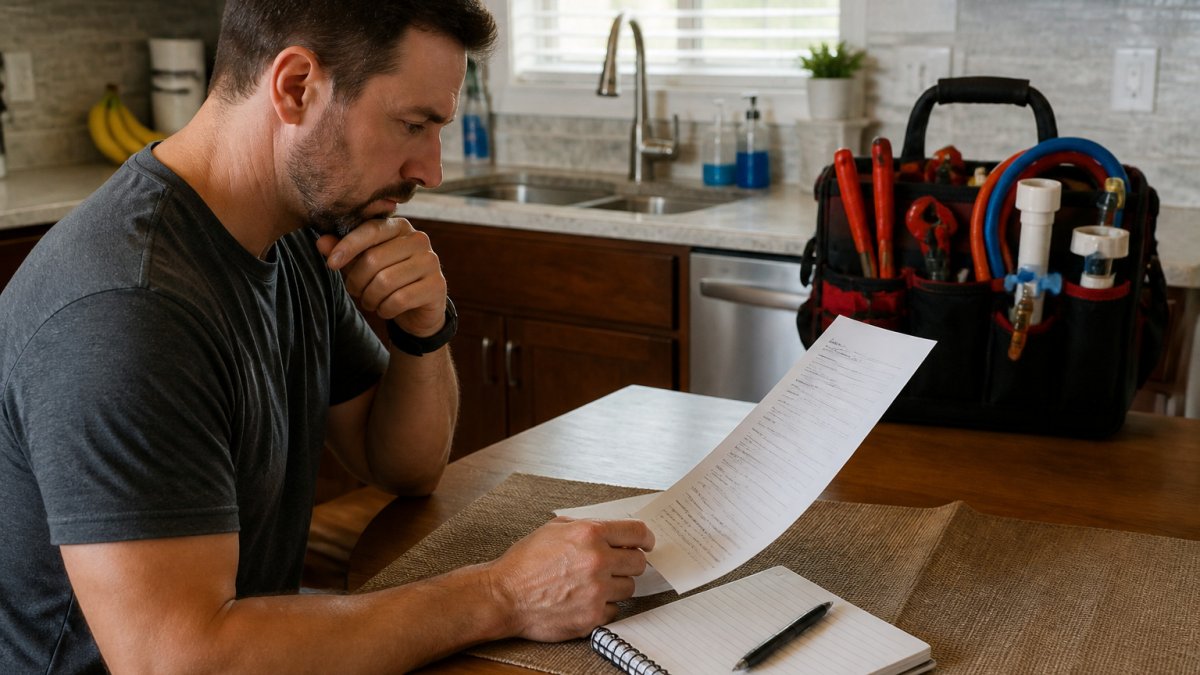
- Describe the job in writing. Give each plumber the same details, photos, and any symptoms you have noticed. A written description keeps each plumber from scoping a different job.
- Request an itemized estimate. Ask for every charge listed on its own line, including trip, diagnostic, labor, parts, permits, and disposal.
- Confirm license and insurance. Ask for the license number and verify it with the state licensing board before comparing prices. A low quote from an unlicensed provider is not a comparable quote.
- Line up the estimates side by side. Build a simple table with one row per line item and one column per plumber. Mark any line a plumber left blank and ask whether it is included.
- Normalize the scope. If one plumber proposes replacing a part and another proposes repairing it, ask each to quote the same scope so you are comparing like for like.
- Ask about anything that differs. Ask directly which line items are excluded.
- Confirm the final number in writing. Do not rely on a verbal price. Ask for the estimate by email or text so you have a record.
A simple comparison table to build
You do not need software. A spreadsheet or a sheet of paper with these rows works:
- Trip or service call fee
- Diagnostic or inspection fee (and whether it is credited)
- Minimum labor charge
- Hourly rate and estimated hours
- Parts, itemized
- Permit fee
- Disposal and cleanup
- After-hours premium, if applicable
- Total with tax
- Warranty terms
- Payment schedule
Fill in every cell. Where a plumber wrote “included,” note what it is included in.
How to research fair local rates
Ask each plumber the same questions so the answers are comparable, and note the date of each quote.
Do not sign a work authorization that includes a blank total or an open-ended “plus materials” clause. Ask for the materials to be estimated or capped before you sign.
Verify before you approve
Before work begins, confirm three things in writing: the final scope, the total price, and the process for approving any added work. Ask the plumber to state in the estimate that no additional work will be performed without your written approval.
The table below sets out the steps for getting and comparing written estimates, with the time or frequency for each.
| Step | What to do | Time or frequency |
|---|---|---|
| Describe the job in writing | Give each plumber the same details and photos | Before requesting quotes |
| Request an itemized estimate | Ask for every charge on its own line | Per plumber |
| Confirm license and insurance | Verify the license with the state licensing board | Before comparing prices |
| Line up the estimates side by side | Build a table with one row per line item | When all quotes are in |
| Normalize the scope | Ask each plumber to quote the same work | Before comparing |
| Ask about differences | Ask which line items are excluded | Before comparing |
| Confirm the final number in writing | Get the estimate by email or text | Before approving work |
Handling a Plumbing Change Order Before Work Begins
A change order is a written approval for work beyond the original scope (Learn About Home Improvement Contracts). It protects both you and the plumber. Before any extra work starts, the plumber should explain the new problem, show the added cost, and wait for your approval.
Do not agree to additional work over the phone without a written update. If a plumber finds something unexpected, ask them to pause and send a revised estimate. You can then decide whether to proceed, get a second opinion, or wait.
If a dispute arises, keep copies of every estimate, change order, and invoice.
Emergency and After-Hours Pricing: What to Confirm Up Front
Confirm the terms before the technician arrives. Ask whether nights, weekends, or holidays cost more and whether a minimum charge applies.
Arsenal Plumbing offers 24/7 emergency service, and you can contact Arsenal Plumbing for a quote. Asking these questions early can help clarify charges before work begins.
Booking Your Next Plumbing Visit With Arsenal Plumbing
Arsenal Plumbing has served homeowners and businesses in the San Fernando Valley since 1993. Our certified and insured plumbers provide free estimates. Our team also offers free video inspection with hydrojetting, so you can see the problem before you pay for a repair. When you are ready, you can book your next plumbing visit with our team.
Frequently Asked Questions
How can I avoid hidden fees when hiring a plumber?
Ask for a written estimate that lists labor hours, parts, materials, service call or diagnostic charges, and any minimum fee before work starts. Confirm whether the service call fee is credited toward the repair if you approve it. Request that any change to the scope be submitted as a written change order that you approve before the extra work begins. Compare at least two written estimates for the same scope of work, and treat a vague quote with only a lump-sum total as a warning sign.
What should a plumbing estimate include?
Ask whether the estimate describes the scope of work, parts and materials, labor, fees, warranty terms, payment terms, and how long the quote is valid. Review the invoice against the estimate.
Can a plumber charge more than the original estimate?
Ask how additional work and charges will be handled if a problem is discovered mid-job. Request the proposed changes and cost in writing before deciding whether to proceed, and keep copies of messages and approvals for your records.
Should I get a written estimate before plumbing work begins?
Ask for the estimate in writing, confirm the scope, price, and payment terms, and keep it with your receipt for the final invoice.
