
Quick Summary
Plumbing maintenance for property managers is a scheduled program of inspections, routine service, and a clear plan for who handles each task and when. Running it on a calendar catches small leaks and worn parts before they cause water damage and costly emergency repairs.
- Track monthly and quarterly tasks such as checking under sinks, toilets, and drains for leaks and slow drainage.
- Flush tank-style water heaters annually and inspect the anode rod every two to three years.
- Score each property on pipe age, leak history, occupancy, pressure, and access to rank repair priority.
- Monitor response time, repeat work orders, and leak recurrence to judge vendor performance.
- Write an emergency response plan with 24/7 contacts and tenant instructions for locating the main shutoff.
Table of Contents
- Why Plumbing Maintenance Matters for Rental Portfolios
- Plumbing Maintenance Checklist for Landlords
- Rental Property Plumbing Inspection Schedule and Process
- Prioritizing Repairs Across a Portfolio
- Building a Plumbing Emergency Response Plan
- Setting Up a Property Management Plumbing Contract
- Scheduling Your First Plumbing Walkthrough with Arsenal Plumbing
- Frequently Asked Questions
Last Updated: October 30, 2026
Arsenal Plumbing has served the San Fernando Valley since 1993, and plumbing maintenance is the single task that most often separates a quiet portfolio from one full of emergency calls. Most property managers treat plumbing as something to fix when it breaks.
Plumbing maintenance for property managers means scheduled checks, routine service, and a clear plan for who handles what and when.
Why Plumbing Maintenance Matters for Rental Portfolios
A single unnoticed supply-line leak can soak drywall, cabinets, and flooring before a tenant ever mentions it.
Preventive plumbing care also protects the lease relationship. Tenants who get fast, predictable service are less likely to call with every small issue.
Waiting for failure costs more, since emergency work and resulting damage repairs stack on top of the plumbing repair itself.
Plumbing Maintenance Checklist for Landlords
A good checklist turns maintenance from a vague goal into repeatable work. Assign each task a frequency and a responsible party, then keep a log for every unit. The checklist below is built as a month-by-month operating calendar rather than a seasonal summary, so you can hand it to a maintenance tech, a vendor, or a resident coordinator and get consistent results across a portfolio.
Monthly and Quarterly Tasks
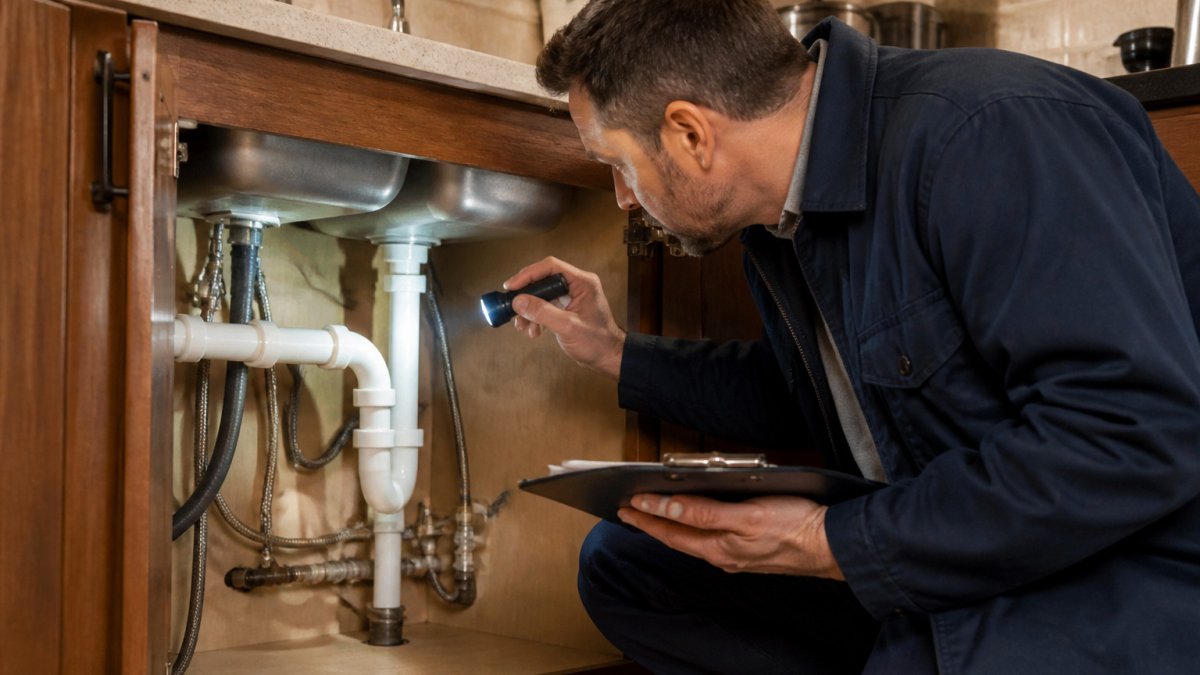
- Check under every sink for drips, staining, or soft cabinet floors
- Look at toilet tanks and bases for slow leaks or loose fixtures
- Run each faucet and shower to confirm normal water pressure and flow
- Test all drains for slow drainage and listen for gurgling
Watch out: Ignoring slow drains is the most common mistake. A drain that drains slowly today often blocks completely within weeks, usually on a weekend.
Month-by-Month Maintenance Calendar
Use this calendar as a template and shift tasks earlier or later based on your local freeze risk. Properties in colder climates should pull winterization tasks forward; properties in hot, dry climates should weight irrigation and water-heater checks more heavily.
| Month | Primary Tasks | Responsible Party |
|---|---|---|
| January | Inspect exposed pipes in unheated spaces; confirm heat tape and insulation are intact; check for freeze damage after cold snaps | Maintenance tech |
| February | Test sump pumps and floor drains; inspect water heater for sediment and check the anode rod | Licensed plumber |
| March | Flush water heaters; test irrigation backflow devices before spring startup; check hose bibs for freeze cracks | Licensed plumber |
| April | Inspect supply lines under sinks and behind appliances; replace braided lines older than 5-7 years | Maintenance tech |
| May | Test outdoor hose bibs and irrigation; check toilet flappers and fill valves; clean aerators | Maintenance tech |
| June | Inspect washing machine hoses; check water pressure at each unit; look for corrosion at shutoff valves | Maintenance tech |
| July | Check water heater temperature settings; inspect for leaks around the unit; test pressure-reducing valves | Licensed plumber |
| August | Clear gutters and downspouts near exterior plumbing; inspect exterior faucets and irrigation for leaks | Maintenance tech |
| September | Insulate exposed pipes; install exterior faucet covers; disconnect and drain hoses | Maintenance tech |
| October | Winterize vacant units; confirm main shutoffs are labeled and accessible; check crawlspace and attic piping | Maintenance tech |
| November | Test all shutoff valves; inspect water heater connections; confirm emergency contacts are current | Maintenance tech |
| December | Post-freeze inspection of exposed pipes; check for ice dams near exterior plumbing; review emergency response plan with tenants | Property manager |
Build the calendar into your property management software as recurring work orders. A task that lives only in a spreadsheet gets skipped; a task that generates a work order gets done.
Water Heater Maintenance Cadence
Water heaters deserve special attention because they fail silently and expensively. Sediment buildup reduces efficiency and shortens the unit’s life. A common pattern is to flush tank-style heaters annually and inspect the anode rod every two to three years; tankless units need descaling at intervals set by the manufacturer and local water hardness. Log the flush date and the anode rod condition for each unit so you can predict replacement rather than react to a burst tank.
Climate Adjustments
A single calendar will not fit every property. For freeze-prone properties, add a pre-winter inspection of every exposed pipe run and confirm tenants know where the main shutoff is. For hot-climate properties, add a mid-summer check of irrigation backflow devices and hose bibs, which crack more often under heat cycling. Document the adjustment in each property’s file so a new maintenance tech can follow the same plan.
Rental Property Plumbing Inspection Schedule and Process
Inspections catch problems that tenants never notice. A consistent process also gives you documentation if a dispute arises later.
Here is a simple process to follow for each unit:
- Schedule the inspection with advance notice that meets your lease and local notice rules
- Walk the unit with a written checklist covering fixtures, supply lines, drains, and the water heater
- Photograph any staining, corrosion, or repairs needed
- Log the results in the property record with the date and inspector name
- Create work orders for each issue and set a priority level
- Confirm completion and update the log
Many managers also use a video walkthrough for remote units, which creates a timestamped record. Arsenal Plumbing offers free estimates and a free video inspection with hydrojetting, which can reveal sewer line problems that a visual check of the fixtures will not show.
Prioritizing Repairs Across a Portfolio
When several properties need work at once, a simple priority system keeps your budget and your tenants’ needs in balance. The tiers below match what most competitors describe, but the scoring model and KPIs that follow are the parts most guides leave out, and they are what make prioritization repeatable across a portfolio.
Repair Priority Tiers
- Urgent: Active leaks, no hot water in winter, sewage backups. Respond the same day; after-hours dispatch is justified.
- Important: Slow drains, running toilets, failing water heaters. Schedule within the current week.
- Routine: Cosmetic faucet issues, planned upgrades, preventive service. Schedule within the current quarter.
Portfolio Risk Scoring
Score each property on a simple 1-5 scale for each factor, then multiply or weight the factors to produce a risk rank. A common pattern is to weight pipe age and leak history most heavily because they predict failure best.
| Factor | What to Measure | Suggested Weight |
|---|---|---|
| Pipe age and material | Years since last repipe; presence of galvanized, polybutylene, or known problem materials | 30% |
| Leak history | Number of leak work orders in the past 24 months | 25% |
| Occupancy and turnover | Vacancy rate and turnover frequency; vacant units are cheaper to service | 15% |
| Water pressure and quality | Recorded pressure readings; hardness or corrosion indicators | 15% |
| Access difficulty | Crawlspace, attic, or slab access that raises repair cost and time | 15% |
Multiply each score by its weight and sum the results. Rank properties from highest to lowest risk and allocate the preventive maintenance budget down the list until it is exhausted. Re-score quarterly so the ranking reflects current conditions.
Plumbing Maintenance KPIs and Reporting
A prioritization model is only as good as the data feeding it. Track these measures for each property and each vendor:
- Response time: Hours from work-order creation to plumber arrival, split by urgent and routine calls
- Repeat work orders: Percentage of repairs that generate a second work order on the same fixture within 30 days
- Leak recurrence: Number of leaks at the same property within 12 months
- Preventive-task completion: Percentage of scheduled calendar tasks completed on time
Review these KPIs monthly with your vendor and quarterly with ownership. A vendor that cannot report response time and repeat work orders is a vendor you cannot manage.
Using the Data to Allocate Budget
Track the cost of each repair and the KPI trends together. Over time, this data shows which properties justify larger upgrades instead of endless patch work. A property with rising leak recurrence and a high cost per unit is a candidate for repipe or fixture replacement; a property with stable KPIs and low cost per unit can stay on the routine calendar.
Building a Plumbing Emergency Response Plan
Emergencies happen after hours, on weekends, and during holidays. A written plan means your team knows exactly what to do before the water starts flowing.
Your plan should include:
- A list of emergency contacts, including a 24/7 plumber
- Instructions for tenants on locating and shutting off the main valve
- A rule for when to call the plumber versus a general maintenance tech
- A process for documenting damage with photos for insurance
- Steps for notifying affected tenants quickly
Arsenal Plumbing offers 24/7 emergency service for homeowners and property managers. Share the number with every tenant and keep a copy in each unit’s file.
Setting Up a Property Management Plumbing Contract
A written contract protects both sides and sets clear expectations for response times and scope. Before signing, confirm these points:
- Scope of services: Which routine tasks, repairs, and inspections are included
- Response time: How quickly the plumber will arrive for urgent and routine calls
- Pricing structure: Pricing depends on the scope of work, the type of repair, and the timing of the visit, so ask for a written estimate. Arsenal Plumbing offers free estimates, and you can request a current quote from the company’s website.
- Billing terms: How invoices are issued, how change orders are approved, and how fees are handled
- Insurance and licensing: Proof of licensing, bonding, and insurance before work begins
Ask for clear written terms on after-hours charges. Surprise fees are a common frustration, so the contract should spell them out before work starts.
Scheduling Your First Plumbing Walkthrough with Arsenal Plumbing
Your first walkthrough sets the baseline for everything that follows. Arsenal Plumbing can review your properties and help identify existing problems.
Before the visit, gather the following:
- A list of properties and unit numbers
- Known problem areas and past repair records
- The age of each building, if available
- Any recurring issues tenants have reported
During the walkthrough, ask the plumber to demonstrate the main shutoff for each property and to flag any items that need near-term attention.
Arsenal Plumbing has served the San Fernando Valley since 1993, with certified, insured plumbers and no hidden fees.
Frequently Asked Questions
How often should rental property plumbing be inspected?
Most property managers inspect visible plumbing at each unit turnover and at least once a year, with a quick check of water heaters, shutoff valves, and under-sink supply lines every quarter. Units with older galvanized pipes or a history of leaks justify more frequent checks. Keep a dated log of each inspection so you can show what was checked and when, which helps with both planning and disputes over tenant-caused damage. Ask your plumber to flag any slow drains or corrosion during routine visits.
What plumbing maintenance tasks should property managers schedule?
Schedule drain clearing, aerator cleaning, water heater flushing, supply-line inspection, and toilet and faucet checks on a recurring basis. Water heaters usually need annual flushing and anode rod checks. Drains in kitchens and commercial-adjacent units often need cleaning every few months. Pair these tasks with your plumbing maintenance checklist for landlords so every unit receives the same baseline service, and track completion in your work-order system.
How can property managers prevent plumbing emergencies?
Most emergencies start as small problems: a slow drain, a weeping supply line, or a running toilet. Inspecting for these early, insulating exposed pipes before freezing weather, and replacing aging flexible supply lines reduces the chance of a burst at 2 a.m. Give tenants a clear way to report leaks immediately and a list of what to shut off. A written plumbing emergency response plan shortens response time when something does fail.
What should a property manager include in a plumbing maintenance contract?
A property management plumbing contract should define the scope of services, response times for routine and emergency calls, how work orders are submitted, and how pricing is quoted and approved. Ask for written rates, a clear process for after-hours calls, and proof of licensing and insurance. Specify whether the provider will send a quote before non-emergency work begins. Pricing depends on the scope and the specific job, so request a current quote from the provider rather than relying on estimates from this article.
